One of the biggest changes we’ve made at Welcome Church is our approach to church membership, or what we now call belonging. This week I will be blogging each day to explain what we are doing and why we are doing it. To understand it fully, please start at Part 1 rather than jumping in half way through. This blog is Part 2 …
In part 1 we talked about the culture of Belong, Believe Become, which left us with a question:
What about Church Membership?
Membership has been a part of the life and culture of our church for years. Some have been members for longer than I’ve been alive.
Belong, Believe, Become has an impact on this. If belonging is open to all, do we no longer have membership? And if ‘belonging’ is no longer defined as membership, what are we saying? Are we saying that someone who is not yet a Christian is now able to be a church member? Do we have a defined membership anymore? This needs careful thought and first we need to consider:
Where does Church Membership come from?
The first thing to understand is where church membership as we’ve practised it comes from, and the answer surprised me. The first thing to say is that membership as churches like ours often define it doesn’t come from the Bible. The Bible tells us in 1 Corinthians 12v27:
“Now you are the body of Christ and individually members of it”
but to apply that to being added to a specific local church’s membership list is to misuse the meaning of the passage. The passage simply means that all Christians everywhere are a part of Jesus’ body on earth, as though we were his physical ‘members’ – meaning the arms, legs, feet, hands etc.
To avoid confusion, some modern translations phrase it like this:
“Now you are the body of Christ, and each one of you is a part of it”
They’ve changed that word from ‘member’ to ‘part’ in order to remain true to the original text and avoid confusion!
But what else does the Bible say about this?
The Bible makes it clear that, from the earliest days of the church, there were clearly defined local churches. The people who belonged to them knew that they belonged to them and the church leaders knew who their “flock” was, and knew who they were responsible for.
And people could also be put out of a church fellowship too – the ultimate form of church discipline – so there must have been some sense of them first belonging. But there are many different ways to achieve those aims.
So where did our long standing approach originate from?
It’s no surprise that over the years many different ways of being church have been expressed. I would not claim for a moment to have insight into the practice of all types of church over 2000 years of worldwide history! No doubt someone somewhere will know far more than I do, and good for them.
But as a former Baptist Church (of 139 years standing no less) we have the joy of knowing exactly where what we do came from. We can trace it back very easily. The basis of church membership as we have always applied it started not with the Bible, but with a group of Christians called the Anabaptists, who were founded in the 1500’s in Europe. These people were our forerunners, and we can trace our history back to them
Anabaptists
The Anabaptists were a very zealous, faithful and radical group of Christians, who had rediscovered believer’s baptism: the baptism of believers, after conversion, by full immersion in water, after conversion. In a culture where Christianity was pretty much the national sport, where almost everyone was christened as a baby (which, with genuine love and respect to our Anglican brothers and sisters, is not what the Bible means by Baptism) and where the state church held huge political power, they began to practice believer’s baptism, by immersion … and they suffered for it.
Some were martyred for their beliefs, including in this country. We burned people at the stake over this issue in the UK just 400 years ago. If you search for ‘Anabaptists’ on line, you will find this image comes up, showing persecution of this group by both Catholics and Protestants alike:
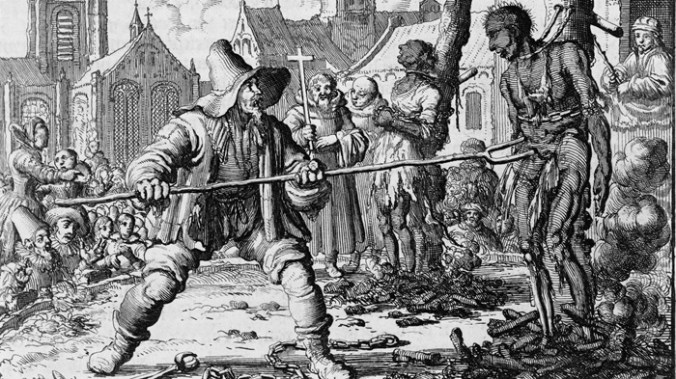
The Anabaptists suffered for their faith at the hands of both Catholics and Protestants
The problem was, these people had broken with the state church. They were no longer under the authority of the Bishops, or of the Pope or the King as the head of the church. They believed in the priesthood of all believers, so they made many decisions by voting to discern God’s will together. And worst of all they were re-baptising people who had been christened as babies. Anabaptists means ‘again baptists’.
In the midst of this persecution they needed to protect themselves, because the members of their churches could vote to change their church practice, their theology and their leadership. Also outsiders might spy on them and report them to the authorities.
So if you wanted to belong to an Anabaptist church, they wanted to know certain things about you first:
- That you were a Christian
- That your lifestyle matched up
- That you had been, or would be, baptised, after coming to faith in Jesus, by full immersion in water. If not you could not join them, because this sort of Baptism defined them and they were suffering for it.
The other members then had a chance to approve of you … in case someone knew something about you that others didn’t
So to be a member you had to be a Christian, to prove your faith through life change, to have been baptised as a believer by full immersion, and to have been interviewed and approved of by the other members. And that helped protect the church from persecution.
To quote a good friend of mine who is a top quality theologian and far more qualified than I shall ever be:
“The Anabaptists put this in place and no one has reviewed it since”
Although that type of persecution has ended for us in the UK, and although this is no longer a Christian nation where everyone is in the state church, the system of membership they began has remained largely unchanged.
It has been replicated in new churches of all sorts ever since, including ours, with perhaps one small change: eldership ‘approval’ replaced congregational ‘approval’ as we ‘rediscovered’ Biblical teaching on eldership, and congregational voting ceased.
Some real benefits
Of course, this sort of membership does bring some real benefits, such as:
- A clarity about who is ‘in’ and who is not
- A moment to really encourage baptism
- A moment to challenge ‘lifestyle issues’
- A route to good discipleship
- A call to a deeper level of commitment
- An ownership of a shared church vision
- A protection in terms of who can lead or serve in certain ministries or roles
Sadly sometimes it’s also used (or misused) by leaders as a handy lever to motivate people to behave how they want them to … the ultimate threat being expulsion!
But in UK culture today it presents a growing challenge:
Increasingly this can make us seem closed. It can make us seem exclusive. It can make us seem heavy and controlling. It can make us seem like a cult. And it can prevent people from feeling that they are able to belong with us while they explore faith.
In fact many churches are finding that this is becoming an increasingly significant barrier to new people, and therefore an obstacle to people meeting Jesus through us.
So what are we to do? How do we respond to this without throwing out the baby with the bath water? Should we just abandon the idea of membership?
I will address this in my future blogs.



 Steve Petch's Blog