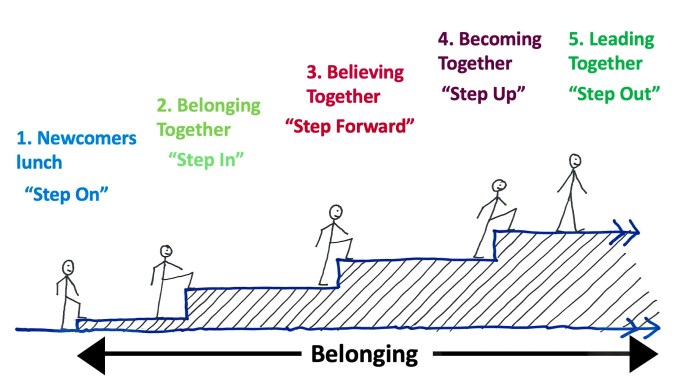
One of the biggest changes we’ve made at Welcome Church is our approach to church membership, or what we now call belonging. This week I will be blogging each day to explain what we are doing and why we are doing it. To understand it fully, please start at Part 1 rather than jumping in half way through. This blog is Part 6 …
In part 5 we looked at the details of our new discipleship track. We finished with a question:
Aren’t there certain people who shouldn’t be allowed to belong to our church? In fact, aren’t we “compromising the gospel” and “going soft on sin”?!?
I’m not surprised when these sorts of questions come up, and I think they are mainly rooted in two things:
- A genuine concern that we might “compromise truth and not truly challenge people on issues of sin and holiness” ... issues which really do matter
- The Pharisee that is hidden inside us all!
Let’s consider them in reverse order, starting with our inner Pharisee.
We might bristle at the idea that we could ever be like the Pharisees, but our hearts can deceive us! It’s very easy to end up becoming Pharisaical towards the very people that Jesus wants to draw to himself. It’s far too easy to turn Christian faith, which is really about a relationship with God, into a programme of sin avoidance … and then to put that onto other people.
So, is there anything of the Pharisee in us? Well, let’s consider a question:
What were the Pharisees like?
The first thing to say is this: the Pharisees were not all bad. If we don’t understand this we run the risk of forgetting that they were real people who believed that they were doing the right thing and were serving God. They were normal people, like you and I. They thought and reasoned like we do. So why were Jesus and the Pharisees constantly at odds with one another?
Some things to understand about the Pharisees:
1. They loved the Bible (though they only had the Old Testament part)
2. They stood for moral values (in a decaying culture)
3. They were evangelistic (“travelling over land and sea to win a single convert”)
Loving the Bible … concerned about moral decay in society … evangelistic for their faith. I don’t know about you, but when I read that list it reminds me of something …
There is one more thing we need to know about the Pharisees though:
4. There was no love in their hearts for broken and sinful people
The Pharisees thought that they were the good people. They thought that they were God’s people. They made sure that they stood apart from any people who they viewed to be sinful, worrying that it might spoil their holiness. Yet for all their passion for God, Jesus sums them up with this phrase:
“You hypocrites! You shut the door of the Kingdom of Heaven in people’s faces.” (Matthew 23v13)
There is a hard truth here:
It’s possible for Christians to think they are faithfully doing God’s work, and yet to completely misunderstand Jesus’ mission to reach lost and broken people.
Jesus told them that he had come to seek and save the lost, that it was the sick who required a doctor and that they should go and learn what this means: “I desire mercy, not sacrifice”. Jesus’ sternest rebukes were spoken against the Pharisees.
Compromising the gospel
Not long ago I was asked a question which was phrased something like this:
“Are you the sort of preacher who will stand up for truth and preach against sin, or are you one of these modern preachers who tells people that God loves them?”
And there is the nub of the issue. In this person’s mind I was either faithful to truth, which meant preaching condemnation against ‘those awful sinners’ – or I was in sinful compromise.
But the truth is that God loves people. He really does. He loves lost, broken and damaged people. He even loves sinful people … which is a good job really when you think about it.
Shockingly God doesn’t withhold his love for sinful people until they repent; Jesus went to the cross for sinful people.
“For God so loved the world that he gave his one and only son, that whoever believes in him might not perish but have eternal life. For God did not send his son into the world to condemn the world, but to save the world through him” (John 3v16-17)
So to preach a message of condemnation is to compromise the gospel. To fail to tell people that God loves them is to compromise the gospel. In fact gospel means ‘good news’, so should we perhaps consider that if our message doesn’t sound like good news to sinful people, we might be compromising the gospel?
The gospel is not a call for us to “pull ourselves up by our bootstraps” and make ourselves good enough to earn God’s love. “God shows his love for us in this: while we were still sinners, Christ died for us.” (Romans 5v8).
But what about the other concern people may have, that we might abandon truth and not really challenge people on issues of sin and holiness?
Does a culture of Belonging mean we don’t challenge anything?
Not at all. Discipleship is all about challenge and guidance. That’s a lifelong thing, and it comes out of relationship. God is making us into the image of his perfect son, Jesus. He’s working in us all the time, and as a church we have a huge part to play in people’s discipleship. Of course discipleship requires relationship, and it’s crucial that we understand this point.
I don’t need to have a relationship with you to condemn you or judge you, but I do need a relationship to disciple you.
So we are not going “soft on sin”, but we are going big on relationship, which is why belonging is vital as a first step. Without this we run the risk of turning people away from Jesus and shutting the door of the Kingdom of Heaven in people’s faces.
Without relationship we run the risk of what I would call compromising the gospel.
By the way, I loved Andrew Wilson’s recent blog which emphasises the need for us not to shy away from the difficult areas of Christian discipleship by simply being silent on certain issues. Here is a link to it. He is much cleverer than I am and this is well worth a read, as is all his stuff.
To encourage you:
- Three Sundays ago we preached a gospel message, clearly highlighting people’s lost and broken state before God and our desperate need for forgiveness. Seven people responded, raising their hands to say they had prayed a prayer of repentance, asking Jesus for forgiveness and committing their life to him.
- Last Sunday we preached about baptism as the first step of obedience for people who are “all in for Jesus”. We challenged people that if they were serious about their faith now, it was time to go public for Jesus. Fifteen people signed up to get baptised.
All of these people are already known to us as a church, and it’s great to see our new approach in action and God at work though it. All of these people already belong to our church, they are all growing in God from a place of relationship with our church, and all of them will have stuff in their life that God wants to free them from. So do you. So do I. Working out what it means to follow Jesus will take the rest of our lives, but we can work these things through whilst belonging.
But what about church discipline? What about excluding people? Didn’t Paul tell us to ‘expel the immoral brother’?
The first thing to say is that it deeply concerns me when someone’s passion for clarity on this issue outweighs their heart for lost and broken people. It really does. It should concern you too.
So if this question is top of your list and you haven’t shared your faith with anyone recently … say in the last month … or year … or ever … give that some thought. Who are you inviting to Alpha? What are the names of your top ten friends who are not yet Christians? How often do you pray for them? What’s your plan to reach them?
But of course, almost every organisation has to be able to say to people, “You can’t come here any more; please do not come back”, whether it’s the golf club, the fishing club, your local pub, the corner shop, your child’s school or a professional organisation. It’s crucial for the health of any organisation to recognise that some behaviours are likely to lead to our exclusion, or in church language ‘excommunication’. The Bible gives instructions on this, and we need to be Biblical.
But is this still possible with a Belong, Believe, Become approach?
Of course it is. We don’t need someone to be on a formal church membership list to be able to confront them for outrageous, divisive, unrepentant, destructive behaviours! Almost every church leader has to do this at some point along the way and it’s not easy. Someone will usually get upset and misunderstand what has been done and why, but that doesn’t mean we don’t do it. (Godly leadership takes courage!)
But let’s get this right and let’s act with love
In 1 Corinthians 5 we read about a man who has gone off with his father’s wife (his step mother we assume, but possibly his mother). Paul says that this type of sin is “not even tolerated amongst the pagans” – and that’s pretty much still true even today.
This was something so destructive that it was bringing God’s church into disrepute and hindering the advance of the gospel, so Paul told them to deal with it … firmly and lovingly. But why was this guy singled out?
You see, the bigger question for me about this issue is this:
What about the rest of the sin present in the church at Corinth?
Isn’t all sin an affront to God’s holiness? Why was this guy singled out for exclusion?
As we read the rest of 1 Corinthians we get a picture of the church, and the surprising thing to me is to find out who was included in it. To be honest it’s concerning. The church included:
- People causing division and arguments
- People who were getting drunk during communion
- People who were eating all the shared food at their communal meals, causing the poor people to go hungry
- People who were suing other people in the church
- Men who were visiting prostitutes in the idol temples and paying them for sex
- Women who were expressing their new freedom by dressing in ways that, in their culture, only prostitutes dressed
- People who were refusing to have sexual relations with their spouse because they thought that celibacy made them more spiritual
- People who were abusing spiritual gifts in worship
- And a whole lot more
Where were all these people?
They were included in the church.
Of course, this doesn’t mean that what they were doing didn’t matter; quite the opposite in fact. We’re aware of these issues precisely because they did matter. That’s why Paul wrote to the church about them.
Yet all these things were addressed in a context of relationship and belonging.
Can we say the same? In recent church history I suspect that most churches would have excluded lots of the people on that list!
But what does Paul say about these issues? He reminds them of who they are in Christ. He appeals to their new nature as new creations in Jesus. He calls them to act towards one another in love. He calls them back to holiness. He warns them about the very serious consequences of what they are doing … in fact he is very blunt with them.
But then Paul had the relationship with them that enabled him to do that.
You see, Paul loved that church deeply; read the letter and you can see for yourself. He was so grateful to God for this messy church made up of people who Jesus had saved and who He loved deeply. This was discipleship in action. This was discipleship of those who belonged, who had come out of a very messy and broken culture, who might take years to learn what it meant to follow Jesus … and who are just like the people God is calling us to reach in the UK today.
But doesn’t this mean we are in danger of having “sin in the camp”? (As I have been asked, albeit not by anyone in Welcome Church – see Joshua 7 for details!)
My answer? There is always sin in the camp! Praise God for his grace! So read Joshua 7, understand that God knows everything you think and everything you do – even the stuff no one else knows about – and then praise God for his grace and mercy in Jesus that covers our sin.
We must be careful before we start excluding the very people who Jesus is trying to reach.
If we want to be Biblical, let’s not be ‘trigger happy’.
Is it possible that 1 Corinthians has more to teach us about discipleship and inclusion than it does about discipline and exclusion?
Certainly it’s something to think about.
Living like Jesus
Ultimately, as a church, we are here to represent Jesus. That’s our calling. The Pharisees taught people a love of the law … but Jesus taught people the law of love, and this led to conflict between them.
The Pharisees accused Jesus of breaking religious rules. They accused him of associating with the wrong sort of people and of being “a friend of sinners”.
Jesus accused the Pharisees of being judgemental, hard-hearted hypocrites, who were lacking in love for people.
But which set of accusations would we get thrown at us today?

The accusing finger strikes again
Is the church in our nation more likely to be accused of breaking religious rules and welcoming sinners, or are we more likely to be accused of being hard-hearted, judgemental hypocrites? In short:
Do people in the UK view the church as being more like Jesus, or more like the Pharisees?
How will we know when we are representing Jesus well? How will we know when we are living like he did? Perhaps one indicator would be that we start to get accused by religious people of the same things that Jesus was accused of by religious people …
One thing is for sure: this needs wisdom and discernment from God and we may not always get it right. Thank God for his grace and his promise that he will build his church.
So there it is. I’ve detailed our new approach to belonging in six posts.
But what if you feel like you’re losing out?
Maybe you’ve been a member for a long time. You made an effort to become a church member and you’ve been faithful to the church for many years. What would we say to you?
I will address this in my final ‘Belonging’ blog tomorrow …